
LCA at a glance
Catalina Crotti
Life Cycle Assessment (or LCA) is THE essential method for understanding the environmental impacts of a product or service. But why conduct an LCA? How do you go about it, and which tools should you use? How reliable is this method? What are the steps involved in summarising the results? Inovacomm explains everything!
LCA stands for Life Cycle Assessment. To give a clear definition, LCA is an assessment method used to quantify the environmental impacts of a service or product throughout its life cycle. According to ADEME, this method is currently the most comprehensive and scientifically robust approach in terms of eco-design and environmental performance.
As a little historical anecdote, the first life cycle analyses were carried out in the United States in the 1960s. In fact, the first LCA study and methodology were developed by Coca-Cola!
The stages of a product’s life cycle
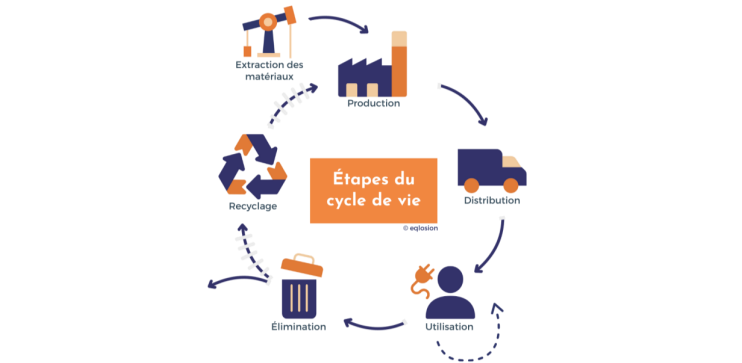
A product’s life cycle consists of five stages:
-
Raw materials: extraction, processing, sourcing, etc.
-
Manufacturing the finished product: assembly, packaging, construction, etc.
-
Distribution: transportation, distribution, and marketing.
-
Product use: unpacking, use, maintenance, etc.
-
End of life: collection, transportation, recycling, waste treatment, etc.
The purpose of an LCA
A Life Cycle Assessment is particularly useful for making more informed decisions throughout a product’s manufacturing process. The results make it possible, for example, to identify the most polluting stages of a product’s life cycle and then find areas for improvement to reduce its environmental impact and make it more sustainable.
The principle is somewhat similar to that of a carbon footprint assessment. Calculating a company’s carbon footprint is the first step in assessing and reducing its emissions. A genuine decision-making tool, the carbon footprint assessment serves as a diagnostic, evaluation, summary, and self-assessment stage before taking action.
LCA can also be used to compare different options and determine which is the most suitable. For example, in distribution, it makes it possible to identify and compare the environmental impacts of different transportation options. We can therefore develop potential scenarios and eliminate those offering the fewest benefits, particularly to protect the environment and encourage eco-design. The same approach can be applied to materials, production techniques, or packaging, for example.
Reducing the environmental impact of our products
Once a product’s environmental assessment has been completed, we understand its environmental and carbon impacts and can take action to reduce them. This approach to designing products in accordance with the principles of sustainable development and environmental protection is known as eco-design.
For example, in the case of a pen, raw materials have a significant environmental impact compared with its use and distribution. To design a more sustainable pen, the focus should therefore be on the extraction of the raw materials required for its manufacture. The questions to ask are: would switching to another material be more beneficial in terms of environmental and carbon impact? Should we change raw material suppliers? In short, it is about assessing and analysing the current situation, almost giving ourselves a score to determine the way forward.
Any organisation offering goods or services can undertake a Life Cycle Assessment. Of course, this requires the necessary knowledge, which often involves training in the LCA methodology. Implementing solutions requires the use and mastery of specific tools, analytical approaches, specialised databases, and more. Even before calculating the various environmental impacts, data collection (activity data and emission factors) is the most time-consuming stage and requires meticulous classification.
At Inovacomm, we set ourselves the challenge of conducting LCAs in 2023. Camille, our CSR Manager, is responsible for collecting data and preparing calculation spreadsheets, although the approach involves the entire team. From designers to the Purchasing Manager and the sales team, everyone is involved in and/or made aware of these sustainability challenges, with the aim of continuously improving. The idea is to think ahead, from the very first stages of a project, in order to design products in the cleanest and smartest possible way for our clients.
To view the detailed results, click here.